
Bipods: Harris vs Atlas vs Magpul


Why Your Bipod Choice Affects Every Shot
A bipod is not just a prop that holds your rifle off the ground. It is a precision tool that directly affects how consistently you can return to position, manage recoil, and hold your point of aim between shots. Shooters who upgrade from a cheap clamp-style bipod to a quality unit often report tighter groups before they change anything else about their setup.
The three brands that come up most often in serious shooting circles are Harris, Atlas, and Magpul. Each one targets a slightly different shooter. Harris is the workhorse most hunters and general shooters already know. Atlas is the benchmark for precision rifle competition. Magpul is the newer option trying to offer solid performance at a friendlier price point. Understanding what separates them helps you spend your money where it actually matters for your style of shooting.
Harris Bipod – Reliable, Affordable, Time-Tested
Harris Engineering has been making bipods since the 1960s, and the design has not changed much – because it has not needed to. The standard Harris S-BRM or S-LM style bipods use notched leg adjustment, a spring-loaded hinge, and a simple swivel stud attachment. They are lightweight, widely available, and affordable enough that most shooters have owned at least one.
The biggest limitation of a Harris is its fixed cant – the legs swivel, but the rifle does not tilt side to side unless you add an aftermarket cant adapter. On flat ground this is rarely an issue. On uneven terrain or in a field position, it can force awkward body angles to get a level reticle. That said, for hunters, casual long-range shooters, and anyone not competing in precision rifle events, the Harris is still one of the best values in the market.
Where Harris Shines
- Hunting rifles where weight and simplicity matter
- Budget-conscious shooters who need reliable function without extras
- Rimfire and centerfire rifles from 22 LR up through 338 Lapua Mag
- Shooters who want a proven product with decades of field history
Atlas BT46 – Smooth Pan and Tilt Precision
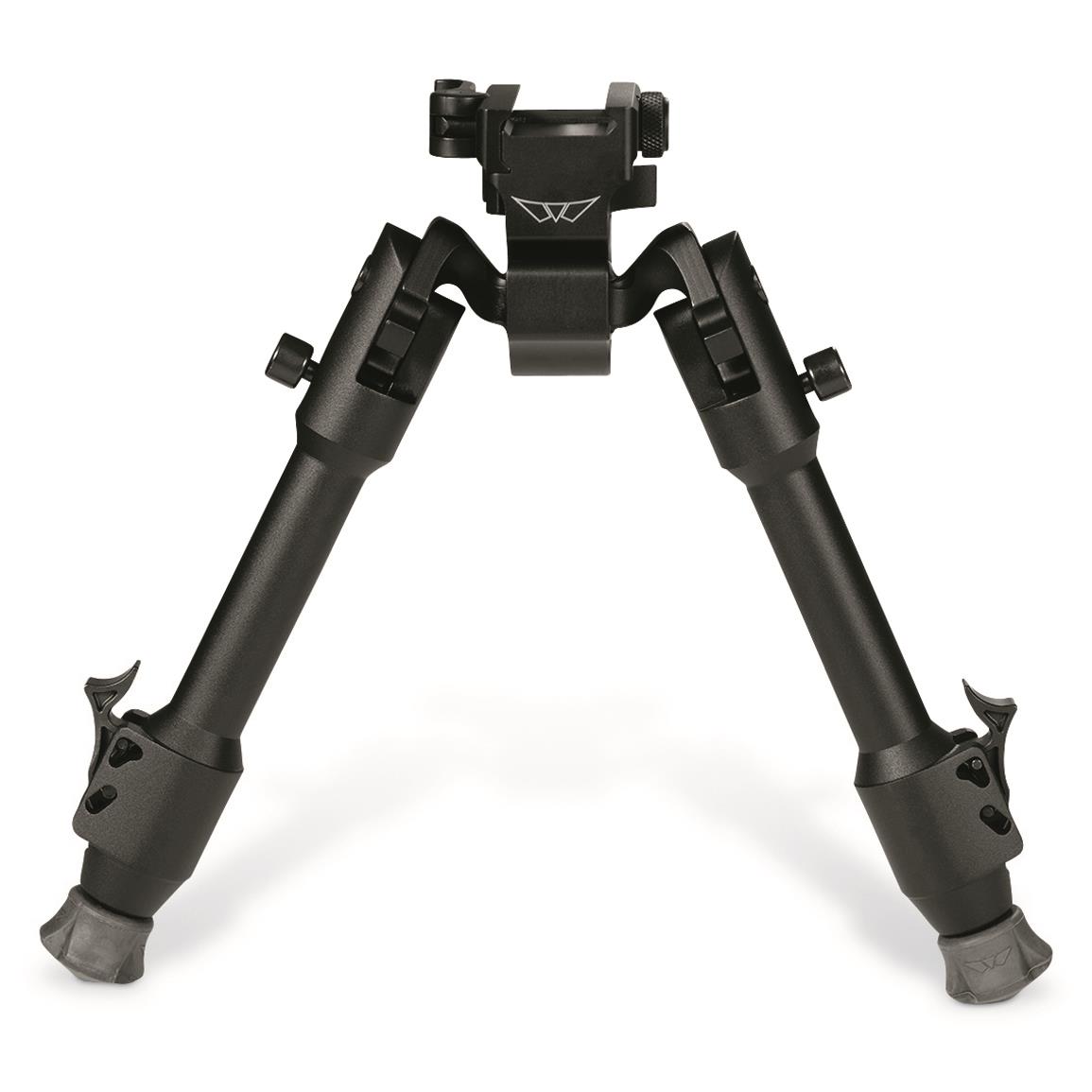
The Atlas BT46 is the bipod most associated with Precision Rifle Series (PRS) competition and high-end tactical use. It offers full pan and tilt adjustment, letting you cant the rifle left or right and swivel smoothly without repositioning your support hand. That level of control is what separates it from both Harris and Magpul in demanding shooting scenarios.
Atlas bipods are built to tighter tolerances than most competitors. The legs lock at multiple positions with a satisfying detent feel, and the pan and tilt tension is user-adjustable. They attach via ARCA rail, Picatinny, or S-Lok depending on the version you choose. The price is significantly higher than either Harris or Magpul, but for a shooter who is serious about andprecision rifle work or competition, the Atlas is often described as a one-time purchase.
Atlas Attachment Options
- ARCA rail – preferred for PRS and bench shooting
- Picatinny – works with most standard rail systems
- S-Lok – compatible with Harris-style swivel stud adapters
Magpul Bipod – New Entry at a Lower Price
Magpul entered the bipod market more recently, and the Magpul Bipod was designed to slot between the Harris and Atlas in both features and price. It offers some cant adjustment, smooth-enough leg extension, and Magpul’s typical solid polymer and aluminum construction. For a shooter who wants more than a basic Harris but is not ready to spend Atlas money, it is a reasonable middle ground.
The Magpul bipod attaches via M-LOK or Picatinny rail, which makes it a natural fit for rifles already running Magpul furniture or modern chassis systems. It is heavier than a Harris and lacks the full pan and tilt precision of an Atlas, but it functions well for general long-range use, hunting, and practical shooting. Magpul’s brand reputation for durability carries over here, and the product has been gaining traction among shooters who want a no-fuss option at a fair price.
Stability and Adjustment – Atlas vs Harris vs Magpul
Stability comes down to how well a bipod eliminates unwanted movement and returns to the same position after recoil. The Atlas leads this category because its pan and tilt system allows you to preload the bipod against the ground, a technique called loading the bipod, without fighting the hardware. Harris bipods can be loaded too, but the lack of cant adjustment means you sometimes have to compensate with your body.
Magpul falls in the middle. It handles basic stability tasks well, but the adjustment system is not as refined as the Atlas under competition conditions. For a hunter shooting from a prone position on flat ground, the difference between all three is minimal. For a competitive shooter moving through multiple field positions in a PRS stage, the Atlas advantage becomes obvious fast.
Features, Weight, and Durability Side by Side
Here is a direct comparison of the three bipods across the specs that matter most to most shooters:
| Feature | Harris (S-BRM) | Atlas BT46 | Magpul Bipod |
|---|---|---|---|
| Pan and Tilt | No (swivel only) | Yes – full | Limited cant |
| Leg Adjustment | Notched | Detent positions | Notched |
| Weight | ~9 oz | ~11 oz | ~14 oz |
| Attachment | Swivel stud | ARCA, Pic, S-Lok | M-LOK, Picatinny |
| Price Range | $80-$120 | $240-$280 | $130-$160 |
| Best Use | Hunting, general | Competition, precision | General, tactical |
Durability is where Harris has the longest track record. Decades of field use across military, law enforcement, and civilian hunting have proven the design. Atlas is built to an equally high standard with tighter machining. Magpul is newer, but the materials and build quality are consistent with their other products. None of these three are likely to fail you in the field under normal use.
Common Mistakes When Choosing a Rifle Bipod
Quick Checklist – Avoid These Before You Buy
- Buying by price alone – A cheap bipod that wobbles costs you more in frustration than it saves
- Ignoring your attachment system – Make sure the bipod matches your rifle’s rail or stud setup before ordering
- Overlooking cant adjustment – If you shoot on uneven terrain, fixed cant will work against you
- Choosing Atlas for casual hunting – You are paying for precision features you may never use
- Choosing Harris for PRS competition – The lack of pan and tilt puts you at a real disadvantage
- Forgetting about weight – Every ounce matters on a rifle you carry all day in the field
- Not checking leg length range – Make sure the extended and collapsed heights fit your shooting positions
- Assuming all Picatinny mounts are equal – Sloppy rail fit introduces exactly the slop you are trying to eliminate
One of the most common mistakes is buying a bipod based on what a favorite shooter or influencer uses without matching it to your own shooting style. A PRS competitor’s Atlas setup is not automatically the right call for a deer hunter who shoots from a blind twice a year.
Features, Weight, and Durability Side by Side
Quick Takeaways
- Harris is the best value for hunters and general long-range shooters who do not need pan and tilt
- Atlas BT46 is the top choice for precision rifle competition and anyone who prioritizes adjustment smoothness
- Magpul fills the gap for shooters who want M-LOK compatibility and more features than Harris at a moderate price
- Weight matters more on a hunting rifle than a bench or competition setup
- Pan and tilt is not a gimmick – it genuinely improves performance on uneven terrain
- All three are durable enough for serious use – this is not a case where only one brand holds up
- Your attachment system (swivel stud, ARCA, Picatinny, M-LOK) should drive part of your decision
FAQ – Harris, Atlas, and Magpul Bipods Compared
Is the Atlas bipod worth the extra cost over Harris?
For precision rifle competition or any shooting where you frequently deal with uneven terrain, yes. The pan and tilt system is a genuine functional advantage, not just a premium feature. For hunting or casual long-range shooting, the Harris performs well at a much lower price.
Can I use a Harris bipod for PRS competition?
You can, but you will be working harder than shooters using Atlas or similar pan-and-tilt bipods. Many PRS stages involve awkward positions where cant adjustment is critical. A Harris with a cant adapter is a workable compromise, but a purpose-built precision bipod is the better long-term investment if you shoot competition regularly.
How does the Magpul bipod compare to Harris?
The Magpul bipod is heavier than Harris, offers some cant adjustment that Harris lacks in its standard form, and attaches via M-LOK or Picatinny rather than a swivel stud. If your rifle already runs M-LOK and you want a straightforward upgrade from a basic bipod, Magpul is worth considering. If weight is a priority or you already have a swivel stud, Harris may serve you better.
What does “loading a bipod” mean and why does it matter?
Loading a bipod means pushing the rifle forward against the bipod legs before firing so the bipod is under tension. This helps the rifle return to the same position after recoil, which improves shot-to-shot consistency. The Atlas handles this technique better than Harris or Magpul because of its pan and tilt system.
What calibers are these bipods rated for?
All three handle standard centerfire rifle calibers without issue – including 308 Win, 6.5 Creedmoor, 300 Win Mag, and similar rounds. Harris has a long track record with heavy recoiling calibers. If you are shooting something in the 50 BMG range, verify the specific model’s weight rating before purchase.
Which bipod is best for a hunting rifle?
Harris is the most popular choice for hunting because of its light weight, simple operation, and proven reliability. If you are shopping for a hunting bipod and want a no-fuss option that will not add bulk to a carry rifle, a Harris in the appropriate leg length range is hard to beat at its price point.





Comments are closed.