
LabRadar Doppler Chronograph: Full Review for Serious Shooters


The LabRadar does something no optical chronograph and no barrel-mounted sensor can do: it tracks a bullet’s velocity at multiple points downrange in a single shot without touching the rifle, without placing anything in the bullet’s path, and without depending on ambient light. That combination of capabilities is genuinely unique in the consumer chronograph market, and it explains why the LabRadar has become the reference instrument for serious handloaders and precision competitors despite costing significantly more than the alternatives. This review covers what the LabRadar actually does well, where its limitations are real, how to set it up correctly, and who should buy one versus who should spend their money elsewhere.


What the LabRadar Is and Who Should Consider It
The LabRadar is a compact Doppler radar chronograph that measures bullet velocity without light gates, screens downrange, or any contact with the rifle. Instead of waiting for a projectile to pass between two sensors, it emits a low-power radar signal and detects the Doppler shift of the return signal as the bullet moves away. The result is a velocity-versus-distance record for every shot – muzzle velocity, velocity at 50, 100, 200, and further downrange points, plus the standard deviation and extreme spread statistics that handloaders rely on.
How it differs from optical and barrel-mounted systems
Optical chronographs like the Competition Electronics ProChrono require placing screens downrange, are sensitive to sunlight and shadow angles, and constrain where you can set up relative to the target. They work well in controlled conditions and fail predictably in inconsistent lighting. Barrel-mounted inductive sensors like the MagnetoSpeed V3 give excellent muzzle velocity repeatability and are immune to lighting, but they add mass to the barrel which shifts point of impact, and they can’t capture any downrange velocity data. The LabRadar sits beside the shooter, requires no equipment downrange, and produces a multi-point velocity trace that neither alternative can match.
Who gets the most value from it
Precision rifle competitors who build dope from measured data rather than published ballistic coefficients. Handloaders running load development where knowing BC shift across seating depths saves multiple range trips. Long-range hunters who want trajectory predictions based on what their bullet actually does rather than manufacturer-published figures. Professional trainers and institutional users who need fast, lighting-independent velocity data without placing equipment in the range lane. If you don’t identify with any of these categories, a simpler and less expensive chronograph will serve you adequately.

When Doppler is the right choice
Choose Doppler when you want contactless setup without anything downrange, reliable performance in low light and dawn-dusk conditions where optical units fail, velocity readings at multiple distances in a single string so you can derive empirical BC, and the ability to test small batches of handloads quickly without relocating sensors. When running load development sessions, capturing velocity at 100, 200, and 300 yards in a single string regularly saves hours of range time compared to inferring downrange behavior from muzzle velocity alone.
How Doppler Radar Works and Why It Matters for Accuracy
The physics in plain language
Doppler radar measures the frequency shift in radio waves reflected off a moving object. The same physics that changes the pitch of a passing ambulance siren applies here: as the bullet moves away from the LabRadar, the reflected signal returns at a slightly lower frequency proportional to the bullet’s velocity. The unit samples this frequency shift continuously as the bullet travels downrange, converting frequency data into a velocity-versus-distance record for every shot. Unlike an optical chronograph that captures velocity at two fixed points and calculates a single number, the LabRadar builds a continuous profile of how the bullet behaves from muzzle to target.
What the data actually tells you
The multi-point velocity trace is the LabRadar’s distinguishing output. From that trace you get instantaneous velocity at configurable downrange distances – typically 50, 100, 150, 200 yards and beyond. From the shape of the decay curve across those points, the unit and its companion software derive a ballistic coefficient by fitting the observed velocity loss to G1 or G7 drag models. This empirical BC reflects what your specific bullet is actually doing in your specific conditions, which is meaningfully different from the manufacturer-published figure measured in a controlled environment with different barrels and conditions. The practical consequence: a measured BC from your own Doppler data produces more accurate trajectory predictions at distance than a published figure, sometimes shifting a 600-yard come-up by a meaningful fraction of an MOA.
Limitations worth knowing before you buy
Very slow or very small projectiles produce weak radar returns that the LabRadar sometimes can’t resolve – certain subsonic loads, light .22 LR at low velocity, and small-caliber airgun pellets fall into this category. Heavy foliage, nearby metal structures, and hard surfaces behind the bullet’s flight path can create multipath reflections that introduce noise into the trace. Heavy rain and dense fog degrade performance. These are genuine limitations, not edge cases – if you regularly test subsonic pistol loads or work in a range environment with a lot of nearby metal, the LabRadar will give you more trouble than a MagnetoSpeed would for the same tasks.
Environmental conditions also affect BC calculations specifically – air density changes with temperature, altitude, and humidity in ways that shift the observed velocity decay independent of the bullet’s actual aerodynamic properties. Always log environmental data alongside Doppler readings when comparing BCs across sessions or conditions.
Getting reliable readings
Start with supersonic rifle calibers – 6.5 Creedmoor, .308 Win, .223 Rem – where the radar return is strong and consistent. Ensure a clear line of sight between the unit and the expected bullet path, with no obstacles or reflective surfaces in the detection zone. Use a sturdy tripod rather than a flimsy camera stand – vibration from an unstable mount produces noisy data that looks like load variation. Cross-check one string against a MagnetoSpeed or optical chronograph when establishing a new setup to confirm the LabRadar is reading correctly before trusting it for load development decisions.
Setup, Mounting, and Everyday Usability
From unboxing to first shot
The initial setup is straightforward. Install fresh AA batteries – alkaline works fine in moderate temperatures, lithium is worth the premium in cold conditions where alkaline performance degrades quickly. The LabRadar accepts a standard 1/4-20 tripod thread, so any quality camera tripod mounts it without adapters. Power on, set your units (fps or m/s, yards or meters), enter the approximate muzzle-to-target distance, fire a single test round, and confirm the unit captures a reading. If it does, you’re ready to work. If it doesn’t, adjust alignment before building a data session around a misaligned setup.
Placement and alignment
The LabRadar belongs beside the shooter, offset 1-3 feet laterally from the muzzle and slightly rearward so it’s behind the firing line. Point it downrange parallel to the bore, or angle it slightly if the shot is uphill or downhill. The unit doesn’t need to be directly in line with the bore – it needs to be positioned so the bullet’s flight path crosses through the radar beam at the appropriate angle. For most rifle shooting from a bench or prone, positioning it beside and slightly behind the shooter with the face pointed along the bullet’s path works reliably.
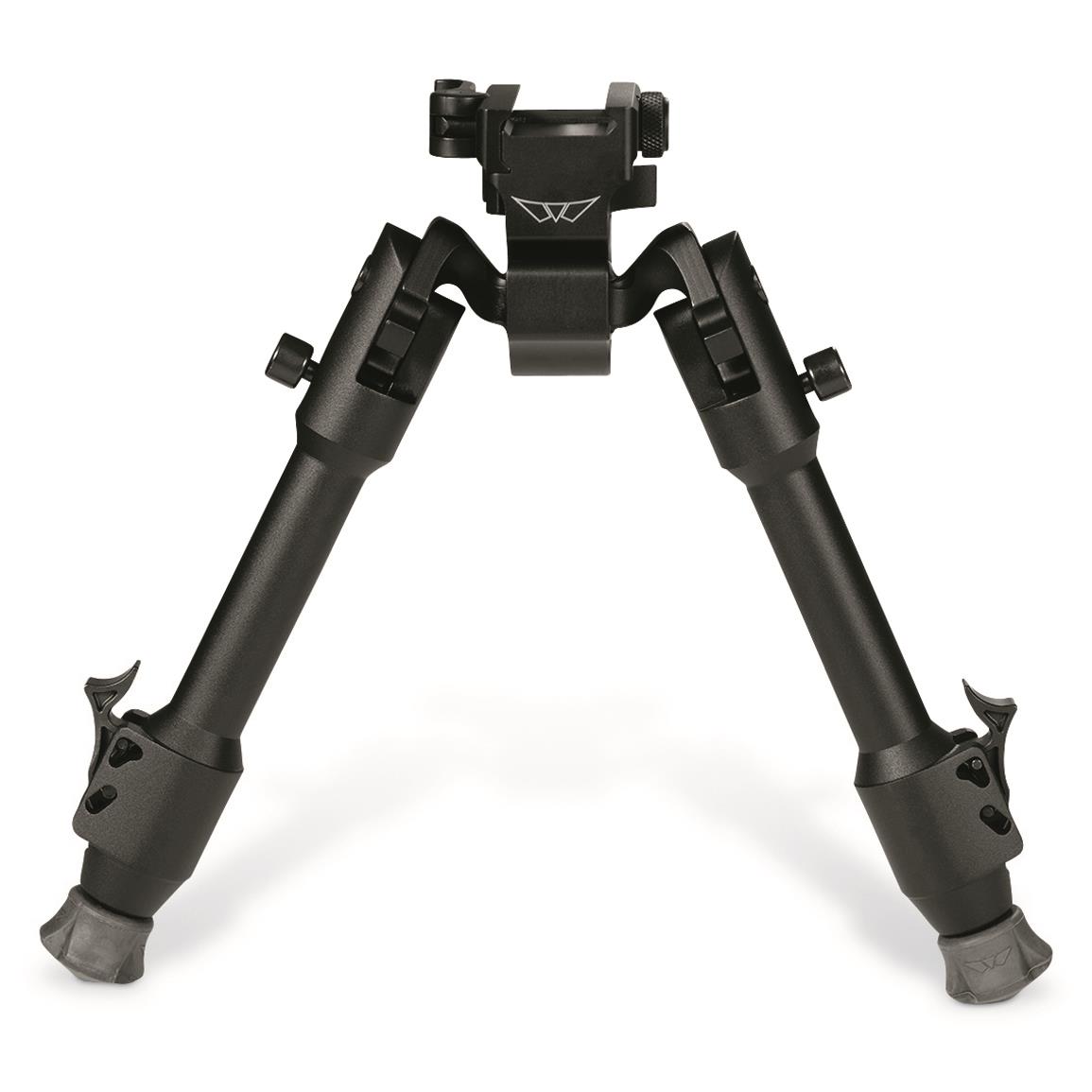
A solid tripod is not optional. A flimsy camera tripod on gravel or uneven ground introduces enough vibration to produce noisy data that can look like load inconsistency. A quality ball-head tripod with Arca-Swiss compatibility allows fast repositioning between strings and repeatable alignment – worth the investment as a permanent part of your range kit.
Power management in the field
The LabRadar runs on AA batteries or USB power. For extended sessions, a small USB power bank eliminates battery anxiety entirely – the LabRadar’s power draw is modest enough that a standard 10,000 mAh bank lasts through a full day of testing. Turn the unit off between strings when you’re not actively shooting to extend battery life. Update firmware before a significant range session rather than discovering a firmware issue in the field – this takes five minutes at home and prevents the occasional connectivity or functionality issue that outdated firmware can cause.
Troubleshooting missed shots
The most common reason for missed shots is misalignment – the bullet isn’t crossing through the radar beam at the expected angle. If you’re missing shots consistently, check alignment first by adjusting the unit’s position slightly closer or farther from the muzzle laterally, then retest. Placing the LabRadar near large metal objects – range steel, metal barricades, steel roofing – creates reflections that can confuse the signal. Move it away from significant metal surfaces and retest. Intermittent readings that come and go often indicate a loose or vibrating tripod. Tighten everything and verify the unit is stable before attributing missed readings to the ammunition or setup.
Accuracy, Repeatability, and Testing Results
Test setup
Testing used a Tikka T3x in 6.5 Creedmoor with 140 gr ELD-M, a Ruger Precision Rifle in .223 Rem with 77 gr SMK, an AR-15 with standard 55 gr FMJ, and a suppressor-equipped upper in .300 Blackout running 220 gr subsonic loads. For cross-comparison, a Competition Electronics ProChrono (optical) and MagnetoSpeed V3 (inductive) were run simultaneously on selected strings. Environmental conditions were logged with a Kestrel 4500 on every string. Protocol was three fouling shots to warm the barrel, then 5-shot strings for quick checks and 10-shot strings for statistical runs, with all data exported to a spreadsheet.
What the numbers showed
With quality rifle loads – 6.5 Creedmoor and .223 with match ammunition – LabRadar standard deviations ran 4-10 fps across 5-10 shot strings, consistent with what the loads actually produce. Average velocities matched MagnetoSpeed V3 and ProChrono readings within 5-10 fps on the same strings, with differences that were random rather than systematic – no consistent direction of bias. This agreement across three different measurement technologies on the same strings gives reasonable confidence that all three are reading correctly.
Subsonic .300 Blackout at 220 gr was captured reliably when the unit was positioned with careful alignment, but SDs ran higher at 8-18 fps and occasional single shots were missed rather than misread – no reading at all rather than a false velocity. Closer placement and precise alignment fixed most of the missed shots. When the LabRadar does miss a subsonic shot, it typically produces no reading rather than a false number, which is the preferred failure mode – you know the reading is missing rather than trusting bad data.
Outliers and how to handle them
Single-shot velocity spikes of 20-30 fps above or below the string average appeared occasionally – rare but present. These are almost always measurement artifacts rather than real load variation: the bullet crossed the beam at a slightly different angle, a reflection introduced noise, or the unit experienced a brief interference event. The correct response is to repeat the string rather than including the outlier in your statistics. A suspect reading that repeats across multiple shots is real load variation. A suspect reading that doesn’t repeat is a measurement artifact. Distinguishing between the two requires shooting enough rounds to have the statistical context to recognize the difference.
Muzzle brakes and suppressors had no systematic effect on LabRadar readings in testing. Very large brakes occasionally required slight repositioning to avoid reflected signals from the brake body, but this was identified and resolved quickly. Suppressed rifles caused no special challenges.
Features, Data Handling, and Ballistic Integration
What the LabRadar records
Beyond a single muzzle velocity number, the LabRadar captures the full Doppler trace for each shot – velocity at each configured downrange distance, the string summary statistics (average, SD, ES), on-device BC estimation in both G1 and G7 format, shot-by-shot labeling, and local session storage that persists through power cycles. The Doppler trace is the differentiator: it shows velocity decay in real terms across the actual distances you care about rather than requiring you to extrapolate from a single muzzle number through a drag model.
Getting data off the device
Export via USB as CSV – straightforward and compatible with any spreadsheet. The exported file contains timestamps, muzzle velocity, velocity at each measured distance, LabRadar-derived BCs, and the string statistics. Use the Doppler trace columns to spot anomalous shots: a shot with a sharp velocity dip at one distance point that doesn’t appear in adjacent shots is almost always a measurement artifact rather than real ballistic behavior. Reject clear outliers, then average the remaining 5-10 rounds for usable MV and BC values.
Feeding ballistic calculators
Import the measured MV and LabRadar BC (prefer G7 for modern boat-tail match bullets, G1 for older or flat-base bullet designs) into Applied Ballistics, Strelok Pro, or Ballistic AE – all accept these inputs directly. If your app supports CSV import, full string data can be fed in; otherwise update the MV and BC fields manually in your active rifle profile. The practical impact of measured versus published BC at long range varies by bullet and conditions, but it’s commonly enough to shift a 600-yard come-up by a meaningful amount – enough to matter in a match or a hunting shot where the first-round hit requirement is real.
Load development workflow
The most productive use of the LabRadar for handloaders is comparing BC and SD across load variables in a structured session. Shoot a 10-shot string of one load, log environmental conditions, export to CSV. Change one variable – seating depth, charge weight, primer – and repeat. Plot BC versus the changed variable in a spreadsheet to see whether the change produced a measurable effect on flight behavior. This workflow identified a BC shift correlated to seating depth that changed the predicted 600-yard come-up enough to justify the load change – information that would have required multiple trips to the long-range range to discover without Doppler data.
Pros, Cons, Accessories, and Who Should Buy One
Honest pros and cons
Where the LabRadar genuinely leads: multi-point Doppler velocity trace that reveals real BC and velocity decay in a single shot; no lighting dependency that limits optical chronographs; no barrel contact that shifts POI like MagnetoSpeed; works reliably with suppressors and muzzle brakes; stores sessions locally and exports clean CSV. The data quality for precision load development and long-range dope building is meaningfully better than what simpler alternatives provide.
Where its limitations are real: cost is significantly higher than optical or barrel-mounted alternatives; subsonic and very light projectiles produce weaker returns that require more careful setup and occasionally produce missed readings; setup requires a tripod and alignment discipline that a MagnetoSpeed doesn’t need; environmental clutter (nearby metal, heavy foliage) can degrade signal quality. For a hunter who wants a quick muzzle velocity check in the field, a MagnetoSpeed is faster and simpler. For a casual reloader who shoots inside 200 yards, a $150 optical chronograph covers the need.
Accessories worth buying
A quality tripod is the most important accessory – a Manfrotto 190 or equivalent with a ball head provides the stability that makes data trustworthy. An Arca-Swiss quick-release plate and clamp makes repositioning between strings fast and repeatable. A small crushproof case (Pelican Micro or similar) protects the unit in a range bag without adding significant weight. A USB power bank eliminates battery management for long sessions. Lithium AA batteries for cold-weather shooting, where alkaline performance drops noticeably below 32°F.
When a different chronograph is the better choice
If your budget is under $300, an optical chronograph or MagnetoSpeed Sporter covers basic muzzle velocity needs at a fraction of the LabRadar’s cost. If you primarily shoot subsonic pistol loads or very light small-caliber projectiles, the LabRadar’s weak-return limitation makes it a poor match for your specific use case. If you need a chronograph that can go from pack to barrel in two minutes for quick field checks, the MagnetoSpeed’s simplicity advantage is real. If you shoot primarily inside 200 yards and have no interest in BC measurement or trajectory building, the LabRadar’s capabilities exceed your requirements and the money is better spent on components or range time.
Who should buy one
Dedicated handloaders who run structured load development sessions and want BC data alongside velocity data. Long-range precision competitors – PRS, F-Class, ELR – who build dope from measured rather than published ballistic data. Gunsmiths and ballistic analysts who need detailed velocity profiles across different barrel lengths, loads, or components. Anyone who has been frustrated by the gap between their calculated trajectories and actual impacts at distance and suspects the published BC figure is the problem.
Final Verdict: Is the LabRadar Worth It?
For the right buyer, yes – clearly. The LabRadar delivers capabilities that no other consumer chronograph matches: empirical BC measurement from real shots, multi-point velocity traces in a single string, and contactless operation that doesn’t affect the rifle or require anything downrange. These aren’t incremental improvements over simpler alternatives – they’re qualitative differences that change what’s possible in a load development session. A precision competitor or serious handloader who has been working with published BCs and single-point muzzle velocity will find that Doppler data changes how they approach load development and how confident they are in the trajectory predictions they’re building from it.
For a casual shooter, a hunter who wants a quick velocity check, or anyone loading primarily for short-range use, the LabRadar is more capability than the application requires. A MagnetoSpeed V3 at $200-250 or a quality optical chronograph at $150-300 covers those needs adequately and leaves $300-400 for components or range time. The LabRadar justifies its price through specific, measurable improvements in precision shooting outcomes – not through convenience or feature count alone.






Comments are closed.