
Weapon Light vs Laser for Home Defense: What Actually Helps You Hit?


Low-light home defense is not a gear problem – it is a physiology problem. Your body under threat is not the same body that practiced at the range on a Tuesday afternoon. Understanding what actually helps you land hits in a dark hallway means understanding what stress does to your eyes, your hands, and your decision-making before you ever buy a single accessory.
How Stress Rewires Your Vision in a Crisis
When adrenaline floods your system, your vision narrows. Tunnel vision is not a metaphor – it is a documented physiological response where your peripheral vision collapses and your focus locks onto the perceived threat. Fine motor skills degrade, your hands shake, and your ability to process multiple focal planes simultaneously drops sharply.

This matters enormously for the weapon light vs laser debate. Traditional iron sight shooting requires your eye to shift focus between three distinct planes: rear sight, front sight, and target. Under extreme stress, most people fixate on the threat and lose the front sight entirely. Any accessory that works with your stress response instead of against it has a real advantage in a genuine emergency.
Weapon Light Basics – Identify Before You Shoot
A weapon-mounted light does one thing nothing else can replicate: it illuminates your target so you know what you are shooting at. That single function is not optional – it is legally and morally required. Shooting at a shape in the dark is how tragedies happen.
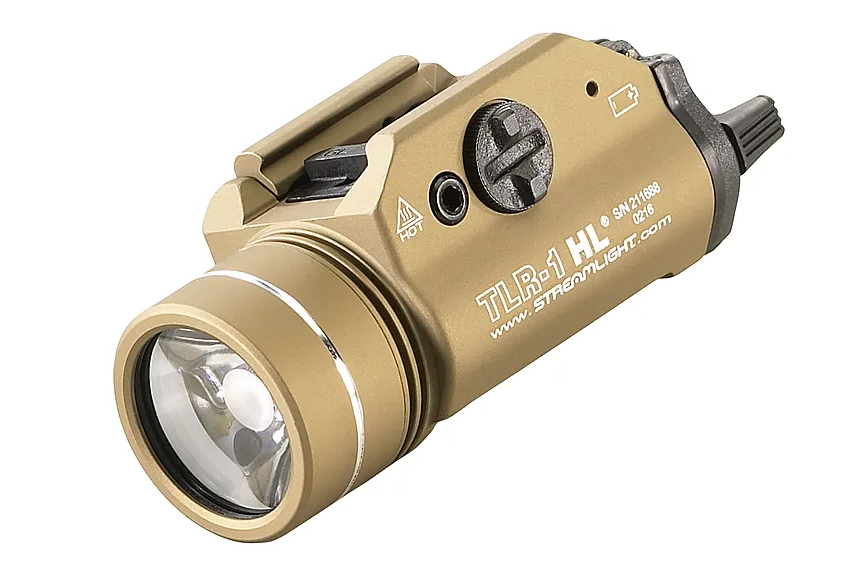
What to Look For in a Weapon Light
- Lumens: 500 lumens is a reasonable floor for indoor use; 1,000+ lumens gives you a disorienting advantage against an intruder
- Beam pattern: A hotspot center with a usable flood prevents the “flashlight tunnel” effect
- Activation switch: Pressure pads and ambidextrous switches matter when your hands are shaking
- Mounting system: Rail-mounted lights stay indexed to your muzzle; a loose fit is a liability
A weapon light also has a secondary tactical benefit – a high-lumen burst will temporarily impair an intruder’s night-adjusted vision. If you have been sleeping and they have not, that disorientation gap can matter. The trade-off is that you require a two-handed grip to run a pistol effectively with a light, which limits your ability to open doors, move a family member, or call 911 simultaneously.
Laser Fundamentals – Dot Speed vs. Dot Dependency
A laser sight projects a point of aim directly onto the target, bypassing the need to align sights at all. For shooters with vision changes, arthritis, or anyone who struggles to pick up a front sight quickly, this is a genuine performance improvement – not marketing fluff.
Green vs. Red Laser for Home Defense
| Feature | Red Laser | Green Laser |
|---|---|---|
| Visibility in daylight | Poor | Moderate |
| Visibility in low light | Good | Excellent |
| Battery life | Longer | Shorter |
| Cost | Lower | Higher |
Green lasers are significantly easier to see in ambient light conditions like a dimly lit hallway or a room with streetlight coming through the curtains. Red lasers are harder to track unless the environment is nearly pitch dark. If you are shopping for a laser, green is worth the extra cost for home defense use specifically.
Why Target ID Always Comes Before Trigger Press
No accessory – laser, light, or optic – changes the legal and ethical requirement to positively identify your target before firing. In a home defense scenario, that target could be a family member, a neighbor, or a pet. Positive identification requires light. A laser dot on an unlit shape tells you where your bullet will go, not what you are shooting.
This is not a philosophical point – it is a practical one with serious legal consequences. In virtually every jurisdiction in the US and Canada, you are responsible for every round you fire. A laser without a light leaves you with a fast shot and no information. That combination is dangerous in a home with other occupants.
Accuracy Under Stress – Where Lasers Actually Fail
Lasers sound like a guaranteed accuracy upgrade. Point the dot, pull the trigger, done. The reality under stress is more complicated. Laser drift – the visible wobble of the dot as your hands shake – makes the dot harder to track than a stationary front sight for some shooters. You are watching your fear in real time, and that can increase anxiety rather than calm your aim.
The second problem is dot acquisition speed. Finding a small red or green dot on an irregular surface in a chaotic moment is not always faster than driving your front sight to the target. Shooters who train consistently with irons often break even or beat laser-only shooters in timed drills under stress. Lasers reward training – they do not replace it.
Flashlight Grip Techniques and Weapon-Mount Trade-offs
If you prefer a handheld light over a weapon mount – or carry a light as a backup – technique matters. The four most common methods each have real trade-offs.

Common Handheld Light Techniques
- Harries grip: Light hand crosses under gun hand, creates isometric tension – good stability, slow to draw
- FBI technique: Light held out to the side and away from the body – offsets your silhouette as a target, reduces weapon control
- Neck index: Light held at jaw level pointing forward – fast and intuitive, limits peripheral illumination
- Syringe/Rogers technique: Light held between index and middle finger, allows a modified two-hand grip – requires significant practice
Weapon-mounted lights solve the grip problem but introduce a different one: your muzzle goes where your light goes. Pointing your firearm at every corner you want to illuminate is a serious safety issue and a legal liability. A dedicated handheld light for searching paired with a weapon light for the moment of confrontation is the setup many experienced instructors recommend.
Common Mistakes That Get Shooters Into Trouble
- Running a laser without any light: You know where the bullet goes but not what you are shooting
- Buying lumens without learning activation: A light you fumble in the dark is worse than no light
- Assuming the dot is always visible: Bright ambient light, smoke, and certain surfaces eat laser visibility fast
- Skipping low-light training entirely: Gear does not substitute for reps in realistic conditions
- Forgetting battery checks: Lasers and lights both fail at the worst moments if you ignore maintenance
- Using a laser as a crutch for poor trigger mechanics: The dot reveals your flinch – it does not fix it
- Ignoring one-handed shooting practice: If your support hand is occupied, can you still operate your light or laser?
FAQ – Lasers, Lumens, and Low-Light Training
Are lasers accurate enough for home defense distances?
Yes – at typical home defense distances of 3 to 15 yards, a properly zeroed laser is accurate. The limitation is not the laser’s mechanical accuracy; it is the shooter’s ability to find and track the dot under stress.
How many lumens do I actually need on a weapon light?
For indoor home defense, 500 lumens is a workable minimum. 800 to 1,000 lumens provides meaningful disorientation effect on a night-adjusted intruder. Beyond 1,000 lumens offers diminishing returns indoors due to blowback off walls.
Can I use just a laser without a weapon light?
Not safely for home defense. Target identification requires illumination. A laser alone does not tell you what you are about to shoot.
Is a laser useful for training new shooters?
Yes – with supervision. A laser provides instant visual feedback on trigger pull and grip consistency. Dry fire with a laser trainer is a legitimate practice tool. The risk is building a habit of ignoring iron sights entirely.
Do I need both a light and a laser?
Many weapon light and laser combo units exist that mount on a standard rail and activate independently or together. If you are shopping for a single solution, a quality combo unit is worth considering – look for intuitive switch placement and a green laser option.
What about Canadian home defense laws – does any of this change?
The gear considerations are identical. The legal threshold for use of force differs by province and situation, but the fundamental requirement – knowing your target before firing – is universal and even more strictly evaluated in Canadian courts.
Quick Takeaways
- Light is mandatory – a laser without illumination is not a complete home defense solution
- Green lasers outperform red in realistic indoor lighting conditions
- Stress degrades fine motor skills; any system you use must be practiced under pressure
- Weapon-mounted lights require muzzle discipline – they are not a casual searching tool
- A combo light and laser unit is a practical middle ground for most home defenders
- Battery checks belong in your regular maintenance routine, not your emergency moment
- No accessory replaces training reps in low-light, stress-simulated conditions







Comments are closed.